Web Register of Personal Data Operator

RPDO

The Registry of Personal Data Operators is a strategically important state information system that has become the primary tool for digital trust and control over the circulation of personal information in the Republic of Belarus. The PRAS team transformed a complex accounting system into a high-load, secure ecosystem that united thousands of accountable organizations and provided millions of citizens with a tool for transparent auditing.

task
Creation of the catalogue of personal data operators with additional information protection
platform
The project has been implemented on a proprietary .NET web application management system
technologies
NET 6, ASP.NET Core MVC, PostgreSQL, HTML, CSS, JS, AngularJS
release date
September 2023
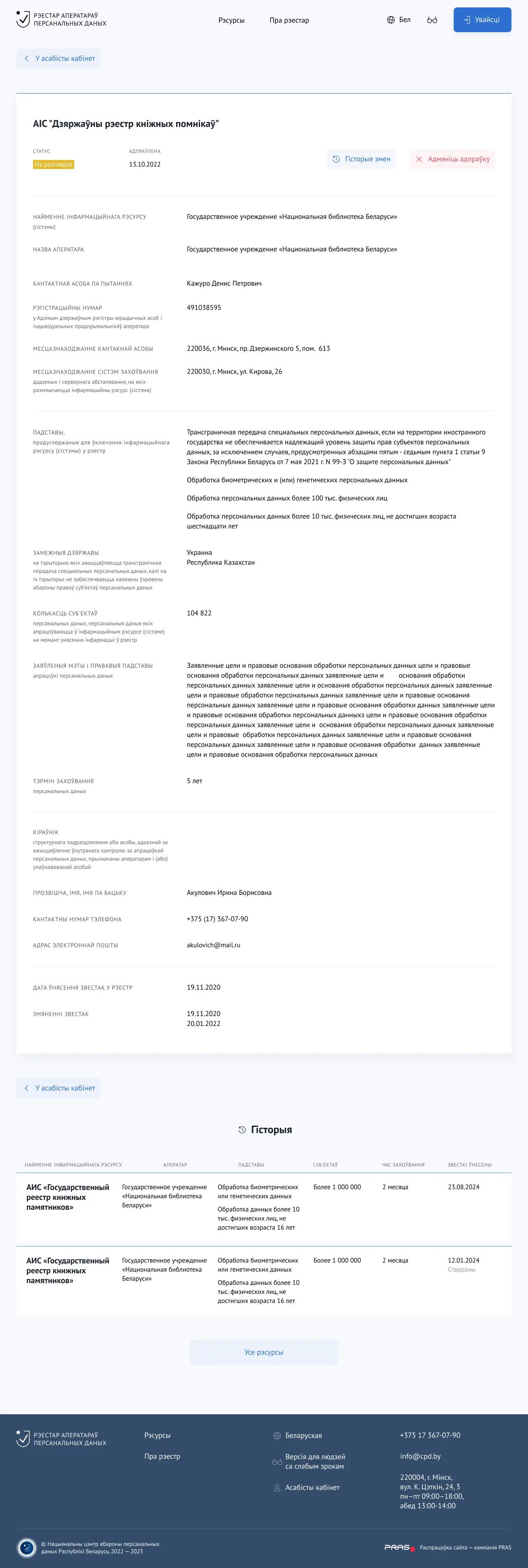
Main page of the project
technical specifications and UI features
  • Instant parametric search: the filtering module is designed to process the database instantly, allowing citizens to find operators by UNP, name, or business sector without any delays.
  • Step-by-step smart forms: interactive declaration wizards are integrated into personal accounts, dynamically adapting input fields to the specific type of organization and reducing the risk of errors during completion.
  • Fault-tolerant architecture on .NET: the backend is optimized for parallel, high-load sessions, ensuring stable operation of personal accounts during peak corporate reporting periods.
  • Role-based access model: the system provides strict separation of access rights, ranging from the regulator's super-administrators to individual access levels for agency staff and operators.
  • Cross-platform adaptive UX: the public registry is optimized to perform flawlessly on any device, guaranteeing the accessibility of socially significant information on both desktops and smartphones.
value for state, business, and users
  • Digital hygiene and security for citizens: the open audit tool allows people to clearly understand who is storing their personal data, for what purpose, and for how long, protecting them from hidden data collection.
  • Reduced compliance costs for business: a user-friendly personal account and automated data validation simplify the declaration process and minimize the risks of regulatory penalties.
  • Automated control for the state: shifting from manual verification to a centralized ecosystem reduces the administrative burden on the agency and eliminates human error in record-keeping.
  • Increased digital trust for the entire ecosystem: the launch of a legitimate state resource enhances the overall transparency of the IT sector and advances the culture of data handling across the nation.
review

The high degree of involvement and coordinated actions of PRAS allowed to develop the state information resource qualitatively and in time, carrying out all the necessary stages of QA.

This review in .PDF
next section of the site
in which

solutions developed by PRAS are demonstrated